
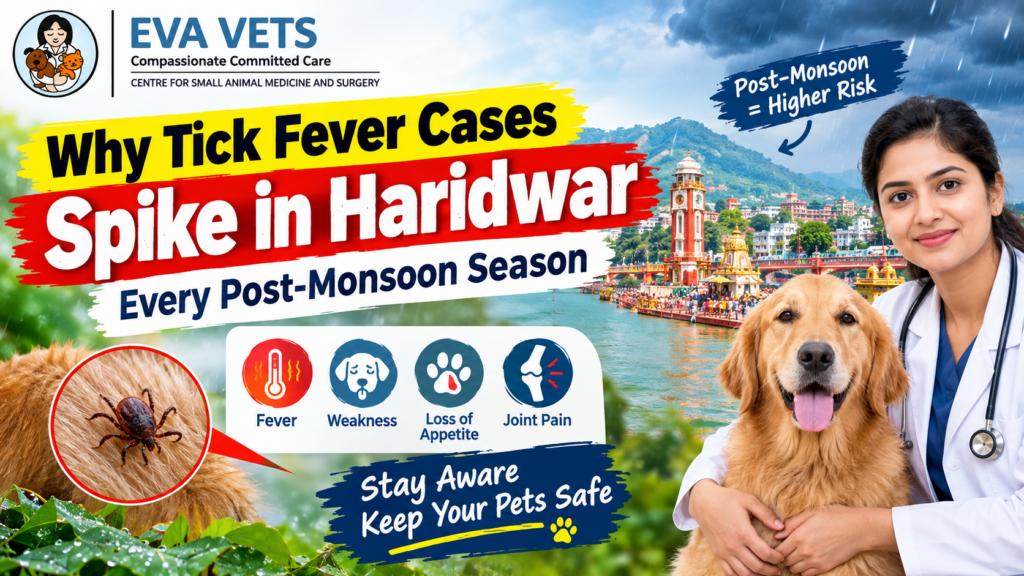
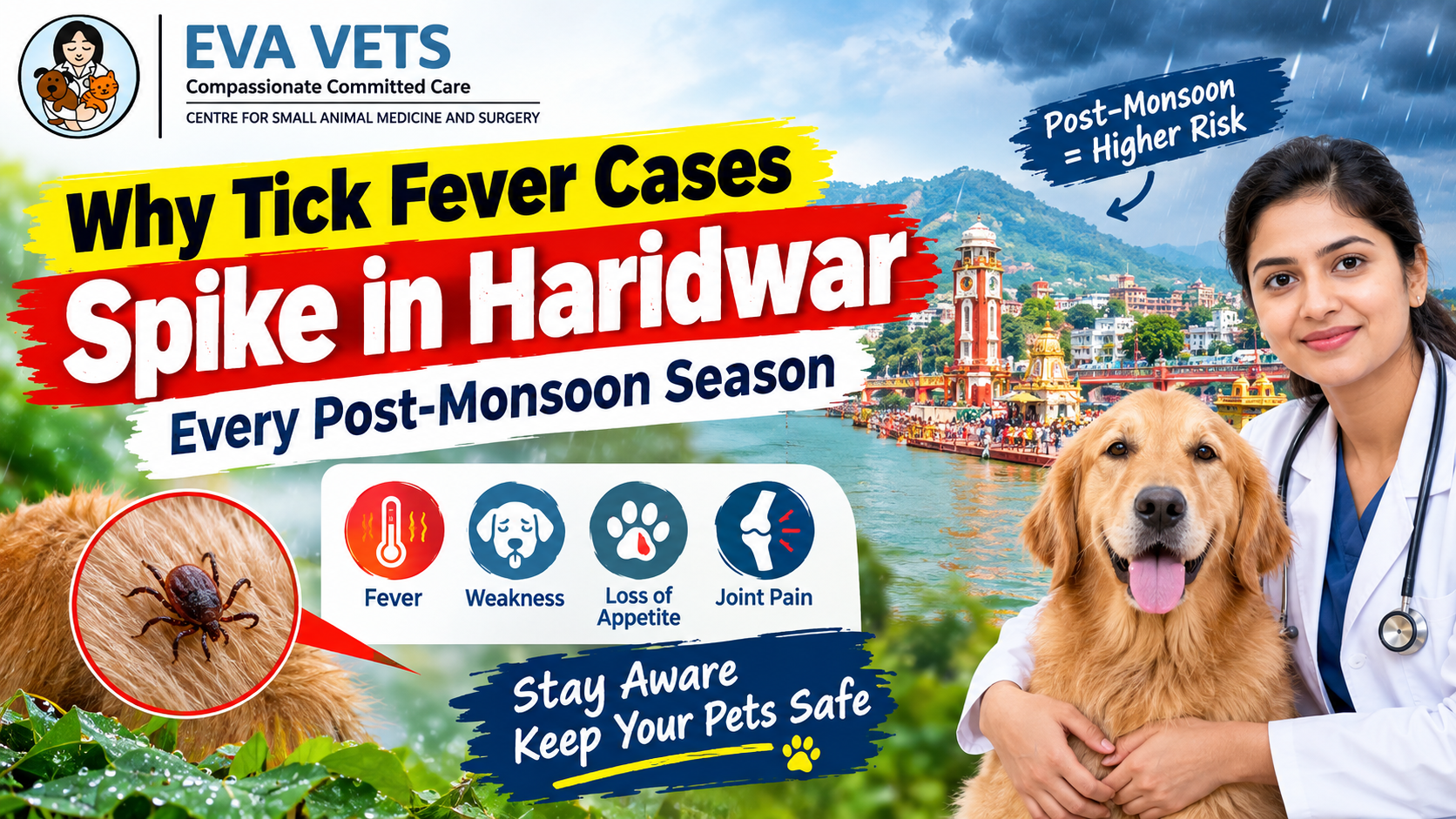
Why Tick Fever Cases Spike in Haridwar Every Post-Monsoon Season
Why Tick Fever Cases Spike in Haridwar Every Post-Monsoon Season If you own a dog in Haridwar, you’ve probably noticed a pattern: every year, right after the rains stop, your
If you own a dog in Haridwar, you’ve probably noticed a pattern: every year, right after the rains stop, your pet’s energy dips, appetite drops, and a trip to the vet suddenly feels urgent. This is not a coincidence. Tick fever cases spike in Haridwar with almost clockwork regularity every September and October, and local veterinary clinics — including our own OPD at Eva Vets Haridwar — see a sharp jump in tick-borne infection cases during this window.
Pet parents often ask us the same question: “My dog was fine all through the monsoon — why is he suddenly so weak now?” The answer lies in a combination of leftover monsoon moisture, tick life cycles, and Haridwar’s unique geography along the Ganga. Understanding why tick fever cases spike in Haridwar after the monsoon can help you catch the disease early, when treatment works best, and before it becomes a medical emergency.
In this guide, we’ll walk you through what tick fever actually is, why Haridwar’s post-monsoon environment is practically an incubator for it, the early symptoms most owners miss, and exactly how our team diagnoses and treats it. We’ll also give you a practical prevention checklist you can start using today.
“Tick fever” is an umbrella term pet owners use for a group of blood infections that dogs pick up from infected tick bites. Ticks don’t just cause skin irritation — they act as carriers, injecting parasites or bacteria directly into the bloodstream while feeding. The four infections most commonly diagnosed in Indian dogs are:
Nearly all of these infections trace back to a single vector common across North India: the brown dog tick (Rhipicephalus sanguineus). Unlike many parasites that need very specific conditions, this tick thrives in warm, humid weather and can complete its entire life cycle indoors, in kennels, courtyards, and garden corners. That adaptability is exactly why it becomes such a problem once the monsoon retreats and humidity lingers.
Haridwar isn’t just “another North Indian city” when it comes to tick risk — its geography and religious tourism create conditions that are unusually favorable for tick breeding and transmission.
After the monsoon, temperatures stay warm while humidity remains high for weeks. Add to this the standing water left behind in canal-side lanes, drainage points, and low-lying residential pockets, and you get near-ideal breeding conditions for brown dog ticks, which need moisture-rich, shaded environments to complete their egg-to-adult cycle.
The greenery along the ghats, the wooded patches near Har Ki Pauri, and the vegetation bordering pilgrim routes all provide exactly the kind of leaf litter and shaded undergrowth ticks use to wait for a host — a behavior called “questing.” Dogs that are walked or allowed to roam near these riverside and wooded stretches have significantly higher exposure.
Haridwar’s large stray dog population, combined with heavy footfall during pilgrimage and Kanwar season, increases contact between pet dogs and untreated stray dogs — many of whom carry ticks. A single friendly sniff or play session near the ghats can be enough for ticks to transfer onto your own pet, which is one more reason tick fever cases spike in Haridwar so predictably every year at this time.
One of the biggest challenges with tick-borne disease is that early symptoms are easy to dismiss as “just a tired day.”
Subtle early signs:
Advanced warning signs (seek care immediately):
This delay is what makes the post-monsoon spike so deceptive. A dog bitten by an infected tick in late August may show no symptoms until mid-September, by which point the owner has often forgotten about the tick altogether. This incubation gap is exactly why vets across Haridwar report the sharpest rise in confirmed tick fever cases two to three weeks after the peak tick activity period, not during it.
When a dog is brought to our Haridwar clinic with suspicious symptoms, our vets don’t rely on guesswork. Diagnosis typically involves:
Dogs diagnosed in the early, mild stage generally respond to treatment within days and rarely develop complications. Dogs diagnosed late — once anemia or organ stress has set in — need longer treatment, sometimes including blood transfusions, and face a higher risk of relapse. This is precisely why our team recommends a same-week lab diagnostic test the moment you notice even mild lethargy in your pet during September and October.
Standard tick fever treatment protocols usually include:
At home, owners should keep the dog in a calm, low-stress environment, encourage small frequent meals, and strictly complete the full antibiotic course even if the dog appears to recover early — stopping treatment prematurely is one of the most common causes of relapse. Most straightforward cases show visible improvement within 5–7 days, with full recovery typically taking 3–4 weeks depending on how advanced the infection was at diagnosis.
Prevention is far cheaper and far kinder to your pet than treatment. Here’s what actually works:
| Method | How It Works | Effectiveness Against Ticks | Vet Recommended? |
|---|---|---|---|
| Spot-on tick preventives | Absorbed into skin oils; kills ticks on contact | High — clinically tested | Yes |
| Oral tick preventive tablets | Circulates in bloodstream; kills ticks after biting | High — clinically tested | Yes |
| Tick collars | Slow-release chemical repellent | Moderate–High | Yes, for added protection |
| Neem oil | Natural repellent scent | Low — inconsistent results | No, not as sole protection |
| Coconut oil | Believed to smother ticks | Low — largely anecdotal | No, not as sole protection |
| Daily manual tick checks | Physical removal before feeding | Moderate (must be combined with other methods) | Yes, as a supplement |
Some symptoms mean you should not wait for a scheduled appointment. Head to the clinic or call our emergency line right away if your dog shows:
These are red-flag signs of advanced tick-borne disease, where every hour of delay can affect recovery outcomes.
Every year, the same pattern repeats: tick fever cases spike in Haridwar in the weeks following the monsoon, driven by humidity, riverside greenery, and increased dog-to-dog contact during pilgrimage season. The good news is that this is one of the most preventable and treatable conditions in veterinary medicine — provided it’s caught early.
If your dog has shown any signs of lethargy, reduced appetite, or mild fever recently, don’t wait for symptoms to worsen. Book a tick-panel blood test at Eva Vets Haridwar today, or call us directly at 7409057999 to schedule a same-week appointment. Early testing this season could be the difference between a quick recovery and a prolonged illness for your pet.
Eva Vets Dehradun
Near Shipra Vihar, Canal Road, Dehradun
📞 7409007999 / 7409117999 / 9193100911 (Emergency)
📧 evavetsdehradun@gmail.com
Eva Vets Haridwar
282A Govindpuri, Haridwar
📞 7409057999
📧 evavetsharidwar@gmail.com

Why Tick Fever Cases Spike in Haridwar Every Post-Monsoon Season If you own a dog in Haridwar, you’ve probably noticed a pattern: every year, right after the rains stop, your