Eva vets

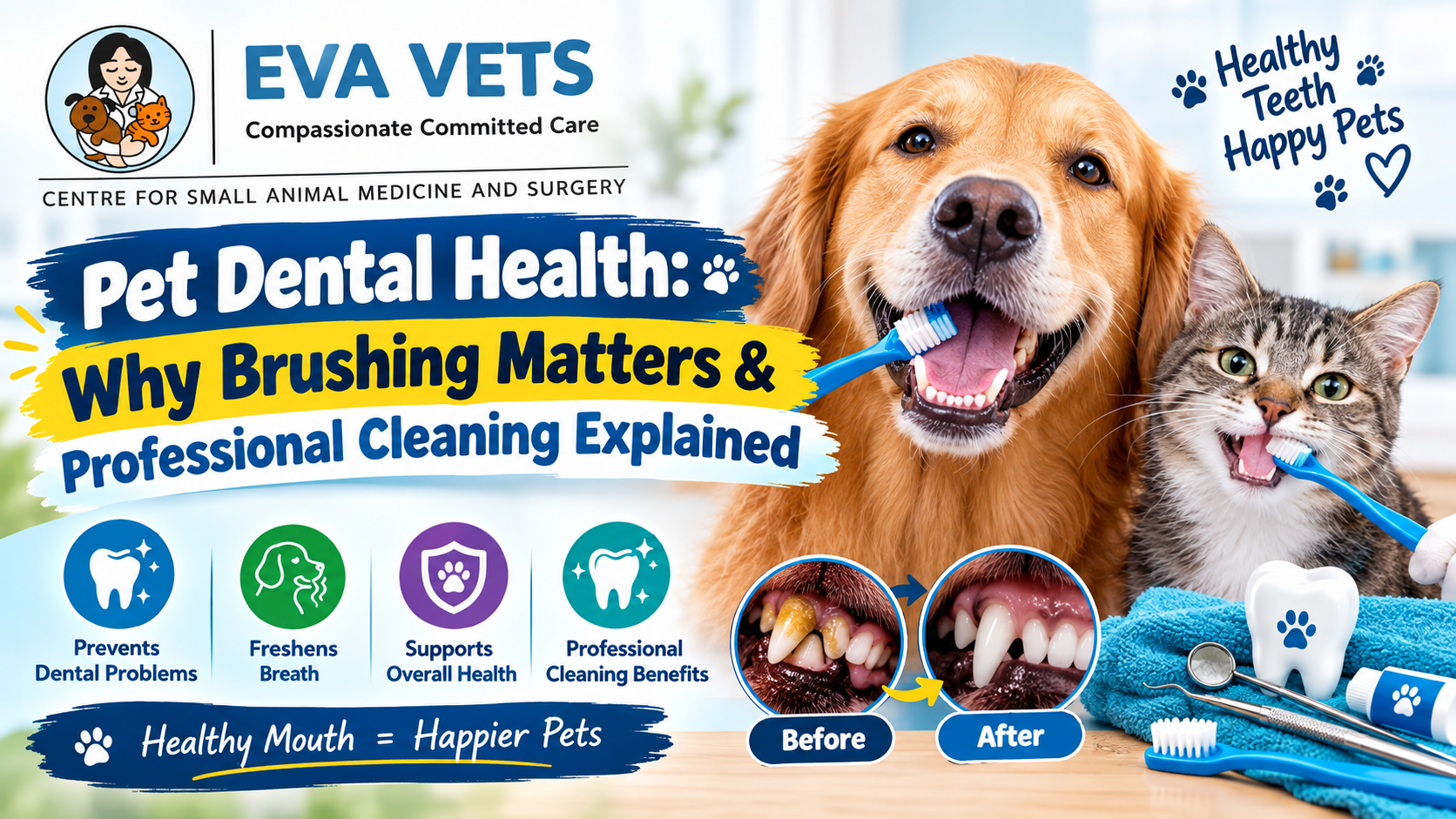
Pet Dental Health: Why Brushing Matters & Professional Cleaning Explained

Pet Dental Health: Why Brushing Matters & Professional Cleaning Explained

Did you know that dental disease affects approximately 80% of pets over the age of three? This shocking statistic reveals a silent epidemic affecting our beloved companions. Yet, many pet parents remain unaware of how critical pet dental health truly is for their furry friends’ overall wellbeing.

Pet dental health isn’t just about fresh breath or a bright smile—it’s a fundamental aspect of preventive care that directly impacts your pet’s quality of life. When dental problems go unaddressed, they can lead to serious health complications affecting the heart, kidneys, and liver. The urgency for pet parents to take action is now more critical than ever. At Eva Vets, we’re committed to helping you understand why maintaining excellent pet dental health should be a top priority in your pet care routine.

Why Dental Health Matters

The Hidden Cost of Ignoring Dental Problems

Pet dental health extends far beyond the teeth and gums. Research has shown that untreated dental disease can trigger systemic infections that compromise vital organs. Bacteria from infected teeth can enter the bloodstream and travel to the heart, kidneys, and liver, potentially causing serious health conditions.

Impact Area Potential Consequences
Heart Endocarditis, valve disease, arrhythmias
Kidneys Chronic kidney disease, infection
Liver Hepatic dysfunction, infections
Overall Health Reduced lifespan, chronic pain

Prevention vs. Emergency: A Financial Perspective

One of the most compelling reasons to prioritize pet dental health is the significant cost difference between preventive care and emergency treatment.

Treatment Type Average Cost Frequency
Annual dental exam $50-200 Once yearly
Professional cleaning $300-800 Every 1-3 years
Emergency extraction $1,000-3,000 As needed
Oral surgery (advanced) $2,000-5,000+ Rare

Pet parents who invest in preventive dental care save thousands of dollars over their pet’s lifetime while ensuring better health outcomes.

Understanding Dental Disease

The 5-Stage Progression of Dental Disease

Pet dental health deteriorates progressively if left untreated. Understanding this timeline helps pet parents recognize warning signs early:

Stage 1 (Day 1-7): Plaque Formation

  • Bacteria and food particles begin accumulating on tooth surfaces
  • Visible plaque appears as a yellowish coating
  • No pain or symptoms present
  • This stage is reversible with proper brushing

Stage 2 (Week 1-2): Tartar Development

  • Plaque hardens into tartar (calculus)
  • Gum inflammation begins (gingivitis)
  • Bad breath becomes noticeable
  • Professional cleaning becomes necessary

Stage 3 (Weeks 2-4): Early Periodontitis

  • Gums start receding and bleeding
  • Tooth structure weakening begins
  • Visible gaps appear between teeth and gums
  • Discomfort may be evident

Stage 4 (Months 1-6): Advanced Periodontitis

  • Significant bone loss around teeth
  • Loose teeth begin falling out
  • Severe infection risk
  • Systemic health impact becomes likely

Stage 5 (6+ months): Severe Disease & Tooth Loss

  • Multiple tooth extractions necessary
  • Severe infection affecting vital organs
  • Chronic pain and behavioral changes
  • Significant quality of life reduction

Common Dental Problems in Dogs and Cats

Pet dental health issues manifest differently between species:

Dogs commonly experience:

  • Plaque and tartar accumulation
  • Gingivitis and periodontitis
  • Broken or fractured teeth (especially in aggressive chewers)
  • Retained baby teeth

Cats commonly experience:

  • Feline Odontoclastic Resorptive Lesions (FORL)
  • Gingivitis and stomatitis
  • Tooth root exposure
  • Difficulty eating hard food

Warning Signs You Can't Ignore

Recognizing early indicators of poor pet dental health allows for timely intervention:

Early Warning Signs

  • Persistent bad breath (beyond normal “dog breath”)
  • Visible plaque or tartar on teeth
  • Increased drooling
  • Reluctance to chew toys

Moderate Problems

  • Bleeding or swollen gums
  • Loose teeth
  • Difficulty eating or chewing
  • Pawing at the mouth

Severe Warning Signs

  • Facial swelling or discharge
  • Behavioral changes and irritability
  • Refusal to eat
  • Bleeding from the mouth
  • Visible tooth loss

If your pet displays any of these signs, contact Eva Vets in Dehradun or your nearest location immediately.

Why Home Brushing Works: The Science Explained

The Mechanism Behind Brushing

Regular brushing is the most effective method for maintaining pet dental health. But how does it work?

When you brush your pet’s teeth, you’re mechanically removing plaque before it hardens into tartar. The bristles disrupt bacterial biofilms on the tooth surface and along the gum line—the exact places where disease begins. This simple action prevents the cascade of dental disease progression.

Evidence-Based Benefits of Regular Brushing

Studies consistently demonstrate that pets whose teeth are brushed regularly:

  • Experience 90% less tartar buildup
  • Maintain healthier gum tissue
  • Avoid 70-80% of dental procedures
  • Live longer, healthier lives
  • Have better overall systemic health

Step-by-Step Brushing Guide for Pet Dental Health

Feeding Schedule and Portion Control

Supplies You’ll Need

  • Soft-bristled pet toothbrush
  • Pet-safe toothpaste (never human toothpaste)
  • Flavored paste (enzymatic formula recommended)
  • Gauze or finger brush (for cats)
  • Treats for positive reinforcement

Dog Brushing Instructions (8 Steps)

Step 1: Choose the right time when your dog is calm and relaxed.

Step 2: Let your dog taste the toothpaste—most are flavored to encourage acceptance.

Step 3: Lift the upper lip gently and expose the upper teeth.

Step 4: Place the toothbrush at a 45-degree angle to the gum line.

Step 5: Use gentle circular motions, brushing the outer surfaces first.

Step 6: Work systematically from back teeth to front teeth.

Step 7: Gently open the mouth and brush the inner surfaces using the same circular motions.

Step 8: Praise and reward your dog immediately after brushing.

Frequency: Daily brushing is ideal; 3-4 times weekly is the minimum for maintaining pet dental health.

Cat-Specific Considerations

Cats require a different approach due to their sensitive nature:

  • Use a finger brush or gauze wrapped around your finger
  • Start with very short sessions (30 seconds)
  • Focus on the outer surfaces—cats naturally groom inner surfaces
  • Be extremely gentle around the canine teeth
  • Use high-value treats as motivation
  • Work up to longer sessions gradually

Cat brushing frequency: 3-5 times per week minimum.

Professional Dental Cleaning: What You Need to Know

When Professional Cleaning Becomes Necessary

While home brushing prevents disease, professional intervention is crucial when:

  • Visible tartar buildup exists
  • Gums are bleeding or receding
  • Bad breath is severe
  • Teeth appear loose
  • Your pet is over 3 years old and has never had professional cleaning

What Happens During Professional Dental Cleaning

At Eva Vets, our comprehensive dental care process includes:

  1. Pre-anesthetic examination – Health assessment and blood work
  2. Anesthesia administration – Safe, monitored sedation
  3. Scaling – Ultrasonic removal of plaque and tartar above and below the gum line
  4. Polishing – Smoothing tooth surfaces to slow future plaque formation
  5. Fluoride treatment – Strengthening enamel and reducing sensitivity
  6. Extraction (if needed) – Removal of non-salvageable teeth
  7. Post-operative care – Pain management and follow-up instructions

Our team at Eva Vets Dehradun uses state-of-the-art dental equipment and follows strict safety protocols.

Cost and Frequency in North India
Service Typical Cost Range Frequency
Dental examination ₹500-1,500 Annual
Professional scaling ₹5,000-12,000 Every 1-2 years
Tooth extraction (per tooth) ₹2,000-5,000 As needed
Full mouth extraction ₹15,000-40,000 Emergency cases

Contact Eva Vets Haridwar or Saharanpur for specific pricing and availability.

Creating Your Comprehensive Dental Care Plan

Age-Based Recommendations

Puppies (Under 1 year)

  • Begin gentle brushing at 4-6 months
  • Establish positive associations with tooth care
  • Monitor eruption of permanent teeth
  • Frequency: 3-4 times weekly

Young Adults (1-7 years)

  • Daily brushing is ideal
  • Professional cleaning at age 3 if needed
  • Maintain consistent home care
  • Frequency: Daily

Senior Pets (7+ years)

  • Increase professional examinations to twice yearly
  • Adjust brushing technique for sensitive teeth
  • Monitor for oral pain and behavioral changes
  • May need extractions but benefits still significant
  • Frequency: Daily (but gentler approach)
Your 30-Day Dental Health Action Plan

Week 1: Get your pet’s teeth professionally evaluated at Eva Vets

Week 2: Purchase appropriate brushing supplies and introduce your pet to toothpaste

Week 3: Begin brushing 3-4 times per week; build comfort and routine

Week 4: Increase to daily brushing and schedule professional cleaning if recommended

Ongoing: Schedule professional cleanings every 1-2 years and maintain daily brushing

Conclusion

Pet dental health is not a luxury—it’s a cornerstone of comprehensive pet care. By understanding the importance of both home brushing and professional cleaning, you’re taking crucial steps to extend your pet’s life and improve their quality of living.

The statistics are undeniable: 80% of pets suffer from dental disease, but with proactive intervention, your pet can be among the healthy minority. Start today with consistent brushing and professional care.

Eva Vets: Your Partner in Pet Dental Health

Our experienced team, led by Dr. Mithila, is dedicated to providing exceptional pet dental health services across North India.

Eva Vets Dehradun
Near Shipra Vihar, Canal Road, Dehradun
📞 7409007999 / 7409117999 / 9193100911 (Emergency)
📧 evavetsdehradun@gmail.com

Eva Vets Haridwar
282A Govindpuri, Haridwar
📞 7409057999
📧 evavetsharidwar@gmail.com

Query Now

Scroll to Top